
Whole Grains vs. Refined Grains: What Changes When You Process Wheat
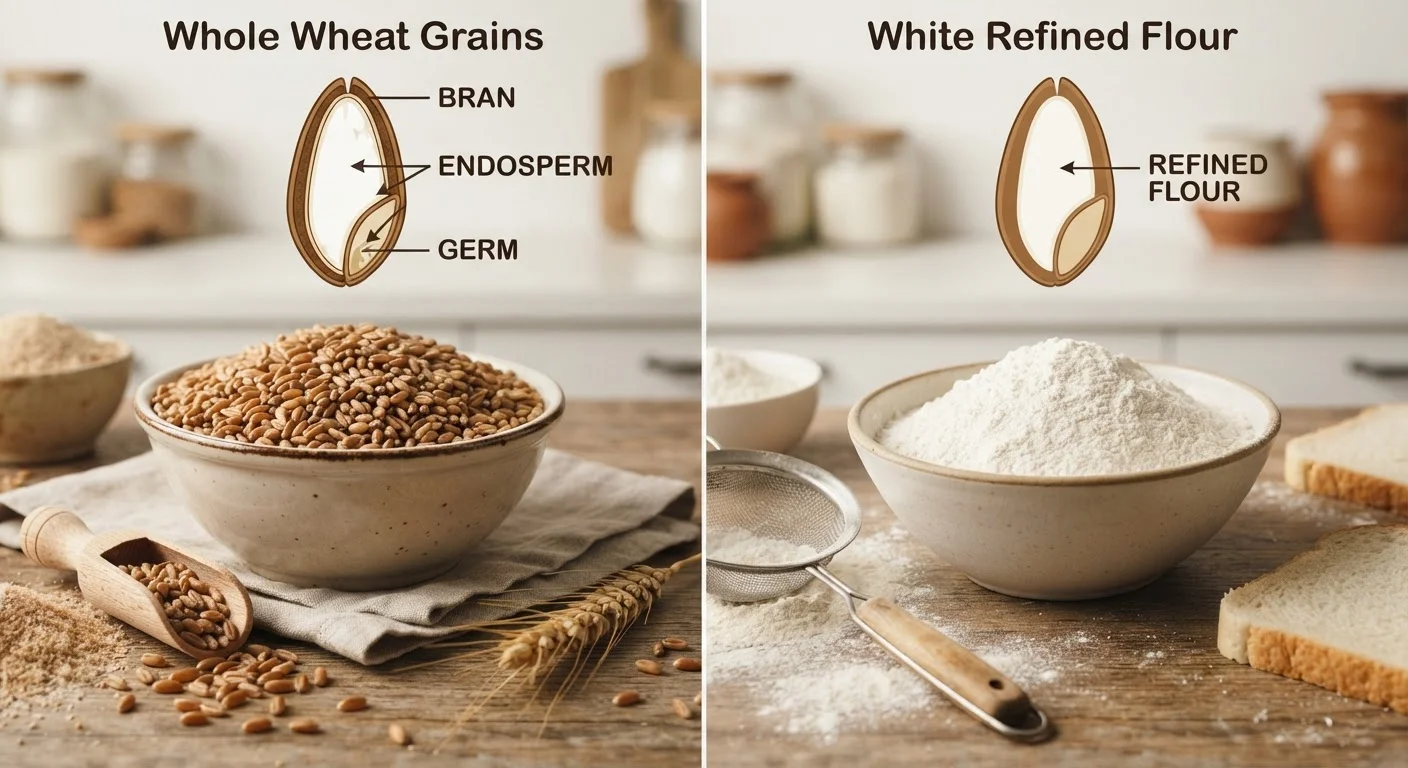
Photo credit: TurboBlogs.net | Explore Blogs At Turbo Speed
In this article
Understand what refining removes from grains, how it affects nutrition, and why the distinction matters for your daily diet.
Key Takeaways
- Milling removes the bran and germ, stripping fiber, vitamins, and minerals from refined grains.
- Whole grains retain all three kernel layers - bran, germ, and endosperm - preserving most nutrients.
- Enrichment adds back some B vitamins and iron, but not fiber or many phytonutrients.
- Dietary guidelines recommend making at least half of daily grain servings whole grains.
- Refined grains are not inherently harmful, but they lack the nutritional density of whole grains.
Inside the Grain: What's Actually There
To understand what refining does, it helps to visualize a single grain of wheat. Every kernel contains three distinct layers, each contributing different nutrients:
- Bran - the outer shell, rich in dietary fiber, B vitamins, and trace minerals such as iron and zinc.
- Germ - the embryo of the seed, packed with healthy fats, vitamin E, B vitamins, and phytonutrients including antioxidants.
- Endosperm - the starchy interior that makes up the bulk of the kernel, providing carbohydrates and some protein but relatively few vitamins or minerals.
A grain is classified as whole when all three components are present in their natural proportions, either intact or recombined after milling. Refined grains have had the bran and germ mechanically removed, leaving primarily the endosperm - a smoother, whiter flour with a longer shelf life but a substantially reduced nutrient profile.
What the Milling Process Removes
The transition from wheat to white flour is efficient and well understood. During standard milling, rollers and sieves strip away the bran and germ to produce a fine, consistent endosperm flour. In doing so, the process removes a significant portion of the kernel's nutritional content.
| Criterion | Whole Grains | Refined Grains |
|---|---|---|
| Kernel components present | Bran, germ, and endosperm | Endosperm only |
| Dietary fiber | High (bran intact) | Low (bran removed) |
| B vitamins | Naturally occurring, full range | Partially restored via enrichment |
| Vitamin E | Present (from germ) | Largely absent |
| Magnesium & zinc | Good natural sources | Significantly reduced |
| Phytonutrients & antioxidants | Present in bran and germ | Substantially removed |
| Shelf life | Shorter (germ fats can oxidize) | Longer, more shelf-stable |
| Texture | Denser, heartier | Lighter, finer |
Fiber loss is among the most consequential changes. Dietary fiber - predominantly from the bran - supports digestive regularity, contributes to satiety, and is associated with favorable blood glucose and cholesterol responses. Most Americans already fall short of recommended fiber intake, so removing it from a staple food has population-level implications.
Enrichment partially addresses nutrient loss. In the United States, refined flour is required by federal standards to be fortified with several B vitamins (thiamin, riboflavin, niacin, and folic acid) and iron. However, enrichment does not restore fiber, vitamin E, magnesium, zinc, or the many phytonutrients and antioxidants lost with the bran and germ. When reading packaged grain products, checking the ingredient list and nutrition label can help clarify what's actually in a product - for guidance on decoding those labels, see reading a nutrition label without the guesswork.
What the Research Says About Health Outcomes
Nutritional science has examined whole grain intake and health outcomes extensively. Large observational studies - including data from cohorts followed over decades - consistently associate higher whole grain consumption with lower rates of cardiovascular disease, type 2 diabetes, and certain digestive conditions. The fiber and phytonutrient content of whole grains are thought to be primary contributors to these associations.
~3x
More fiber in whole vs. refined wheat flour
USDA nutrient data shows whole wheat flour contains roughly 12-13g fiber per 100g compared to approximately 2-3g in enriched white flour.
< 10%
Americans meeting whole grain recommendations
According to dietary intake data analyzed for the Dietary Guidelines for Americans, fewer than one in ten Americans meets the recommended whole grain intake level.
20-25%
Lower cardiovascular disease risk association
A meta-analysis published in the British Medical Journal found that high whole grain intake was associated with approximately a 20-25% lower risk of cardiovascular disease events, compared to low intake.
It is important to note that most supporting evidence comes from observational research, which establishes associations rather than direct causation. Dietary patterns are complex, and whole grain intake often correlates with other healthy behaviors. Still, major health bodies including the U.S. Dietary Guidelines Advisory Committee consider the evidence for whole grain benefits to be strong and consistent.
For refined grains, the picture is more nuanced. Refined grains are not inherently harmful, and in the context of an otherwise balanced diet, moderate consumption of enriched refined grain products does not represent a significant risk for most healthy adults. The concern arises when refined grains displace whole grains as the predominant source of carbohydrates, leaving gaps in fiber and micronutrient intake.
This article provides general nutrition information and is not a substitute for personalized advice from a registered dietitian or qualified healthcare provider.
Practical Ways to Shift Your Grain Choices
The U.S. Dietary Guidelines recommend that at least half of total daily grain servings come from whole grain sources. Making that shift doesn't require eliminating refined grain foods entirely - it's a matter of balance and label literacy.
A few evidence-informed strategies that help in practice:
- Check the ingredient list first. The word "whole" should appear before the grain name (e.g., "whole wheat flour," "whole oat flour"). Terms like "wheat flour," "multigrain," or "stone-ground" do not necessarily indicate a whole grain product.
- Look at fiber per serving. Products with at least 3 grams of dietary fiber per serving are generally considered a good source; those with 5 grams or more qualify as excellent sources.
- Make gradual swaps. Switching from white rice to brown rice, or choosing whole wheat bread over white, are manageable starting points that cumulatively improve daily fiber and micronutrient intake.
- Consider culinary context. Certain recipes perform differently with whole grain flours, which can affect texture. Blending whole and refined flour is a practical approach for some baking applications.
No single food defines a healthy diet. The goal is a pattern of eating that, over time, favors nutrient-dense choices - and whole grains consistently represent one of the more accessible ways to do that.

Author
Health & Wellness Editorial Team
Health & Wellness Editorial Team is the collective byline for our editorial team and contributor network. Articles published under this byline or an editorial pen name are researched, written, and reviewed according to our editorial standards for clarity, consistency, and independence before publication.
View all articles →