
Collision Coverage vs. Comprehensive Coverage: What's the Difference?
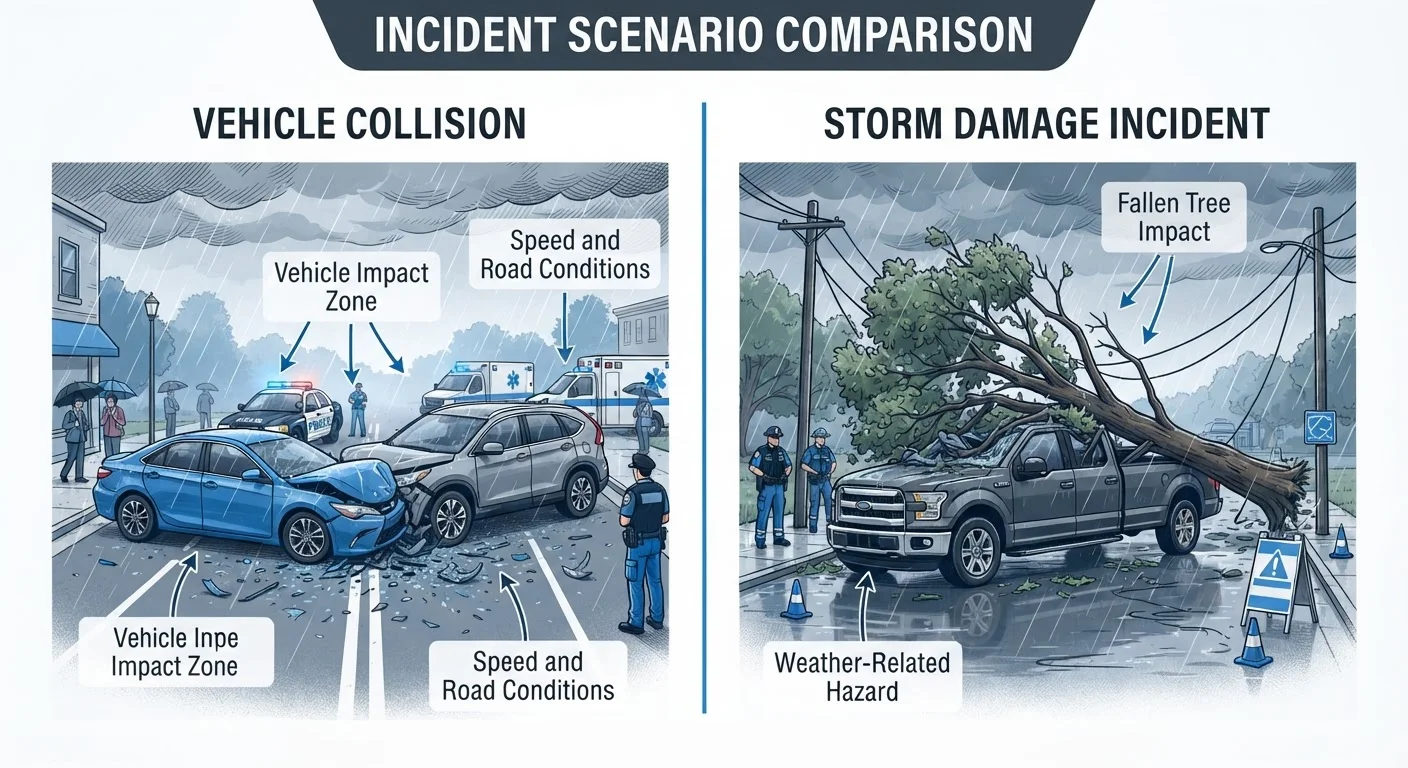
Photo credit: TurboBlogs.net | Explore Blogs At Turbo Speed
In this article
Collision and comprehensive are often bundled together, but they cover very different events. Here's a clear side-by-side breakdown of both.
Key Takeaways
- Collision coverage pays for damage to your vehicle resulting from an accident with another car or object.
- Comprehensive coverage pays for vehicle damage caused by events like theft, weather, fire, or animal strikes.
- Both coverages are subject to a deductible you choose - typically between $250 and $1,500.
- Neither collision nor comprehensive is required by law, but lenders often mandate both for financed or leased vehicles.
- Together, collision and comprehensive are commonly referred to as 'full coverage' alongside liability insurance.
How Each Coverage Type Works
Auto insurance policies are built from several distinct coverage types, each designed to respond to a specific kind of loss. Collision and comprehensive are two of the most commonly misunderstood - partly because they're often sold together and lumped under the informal term "full coverage." But they respond to completely different events.
Collision coverage activates when your vehicle is damaged as a result of a collision - whether that's hitting another car, running into a guardrail, or striking a stationary object like a light pole. Fault isn't always the determining factor; if you're involved in an accident, collision coverage applies to your vehicle regardless of who caused it.
Comprehensive coverage handles damage that occurs outside of a driving collision. Common triggers include theft, vandalism, hailstorms, flooding, fire, falling trees or debris, and strikes involving animals (such as hitting a deer). Think of it as the catch-all for events beyond your control behind the wheel.
For a broader foundation on how these fit into your overall policy, see the core coverage types explained.
| Criterion | Collision Coverage | Comprehensive Coverage |
|---|---|---|
| What triggers a claim | Accident with car, object, or rollover | Theft, weather, fire, animals, vandalism |
| Fault requirement | Applies regardless of fault | Not fault-related; event-based |
| Deductible | Yes (your chosen amount) | Yes (your chosen amount) |
| Legally required | No state requires it | No state requires it |
| Lender/lessor requirement | Usually required | Usually required |
| Typical relative cost | Higher premium on average | Lower premium on average |
| Covers theft | No | Yes |
| Covers weather damage | No | Yes |
Deductibles, Premiums, and the Cost Equation
Both collision and comprehensive require you to pay a deductible - the out-of-pocket amount you absorb before your insurer pays the remainder. Common deductible amounts range from $250 to $1,500. Choosing a higher deductible generally lowers your premium, but means you pay more at claim time.
Collision coverage typically costs more than comprehensive because driving-related accidents are statistically more frequent and more expensive to repair than non-collision events. Comprehensive claims - for hail damage or a stolen catalytic converter, for example - are also common, but the average payout tends to vary significantly by region and circumstance.
~$522/yr
Average annual collision coverage cost (U.S.)
According to the National Association of Insurance Commissioners (NAIC), the average annual expenditure for collision coverage was approximately $522 in recent data.
~$179/yr
Average annual comprehensive coverage cost (U.S.)
NAIC data shows comprehensive coverage costs significantly less than collision on average, reflecting its lower claims frequency and severity in many regions.
~1 in 80
Odds of a vehicle theft claim in a given year
The Insurance Information Institute reports that comprehensive claims for vehicle theft occur at roughly this rate among insured vehicles nationally.
One practical consideration: if your vehicle's actual cash value (ACV) - what the car is worth in the current market - is low relative to your annual premium plus deductible, carrying either or both coverages may not be financially logical. That said, every driver's situation is different, and this article is general educational information, not personalized insurance advice. A licensed insurance agent can help you weigh those specifics.
Drivers often make costly assumptions about what their policy already covers. Common missteps worth avoiding include assuming one coverage substitutes for the other - it doesn't.
When Each Coverage Applies: Real-World Scenarios
Understanding which coverage applies in which situation prevents unpleasant surprises after a loss.
- You rear-end another driver at a stoplight: Collision coverage pays for damage to your vehicle.
- A hailstorm dents your hood and roof: Comprehensive coverage applies.
- Your car is stolen from a parking garage: Comprehensive covers the vehicle loss.
- You swerve to avoid a dog and hit a fence: Collision applies - contact with the fence triggers it, even if the original hazard was an animal.
- A deer runs into the side of your car: Comprehensive applies. Animal strikes are classified as non-collision events.
- A tree branch falls on your car during a storm: Comprehensive applies.
Misunderstanding these boundaries is one of the most common coverage gaps drivers encounter. Many drivers only discover gaps after filing a claim - knowing the distinctions in advance puts you in a stronger position.
The 'Full Coverage' Misconception
The term 'full coverage' has no standard legal or industry definition. It's commonly used to describe a policy that includes liability, collision, and comprehensive - but what it actually covers depends entirely on your specific policy terms and limits. Even a so-called full-coverage policy can have exclusions, caps, and gaps. Always review your declarations page and ask your insurer what is and isn't covered.
For a complete picture of how these coverages fit into your broader policy decisions, Auto Insurance Decoded walks through every major coverage type in plain language.
This article provides general information about auto insurance coverage types and is not a substitute for personalized advice from a licensed insurance professional. Coverage terms, exclusions, and costs vary by insurer, policy, and state. Always review your policy documents carefully and consult a licensed agent for guidance specific to your situation.

Author
Autos & Insurance Editorial Team
Autos & Insurance Editorial Team is the collective byline for our editorial team and contributor network. Articles published under this byline or an editorial pen name are researched, written, and reviewed according to our editorial standards for clarity, consistency, and independence before publication.
View all articles →