
Tankless vs. Traditional Water Heaters: What Maintenance Looks Like for Each
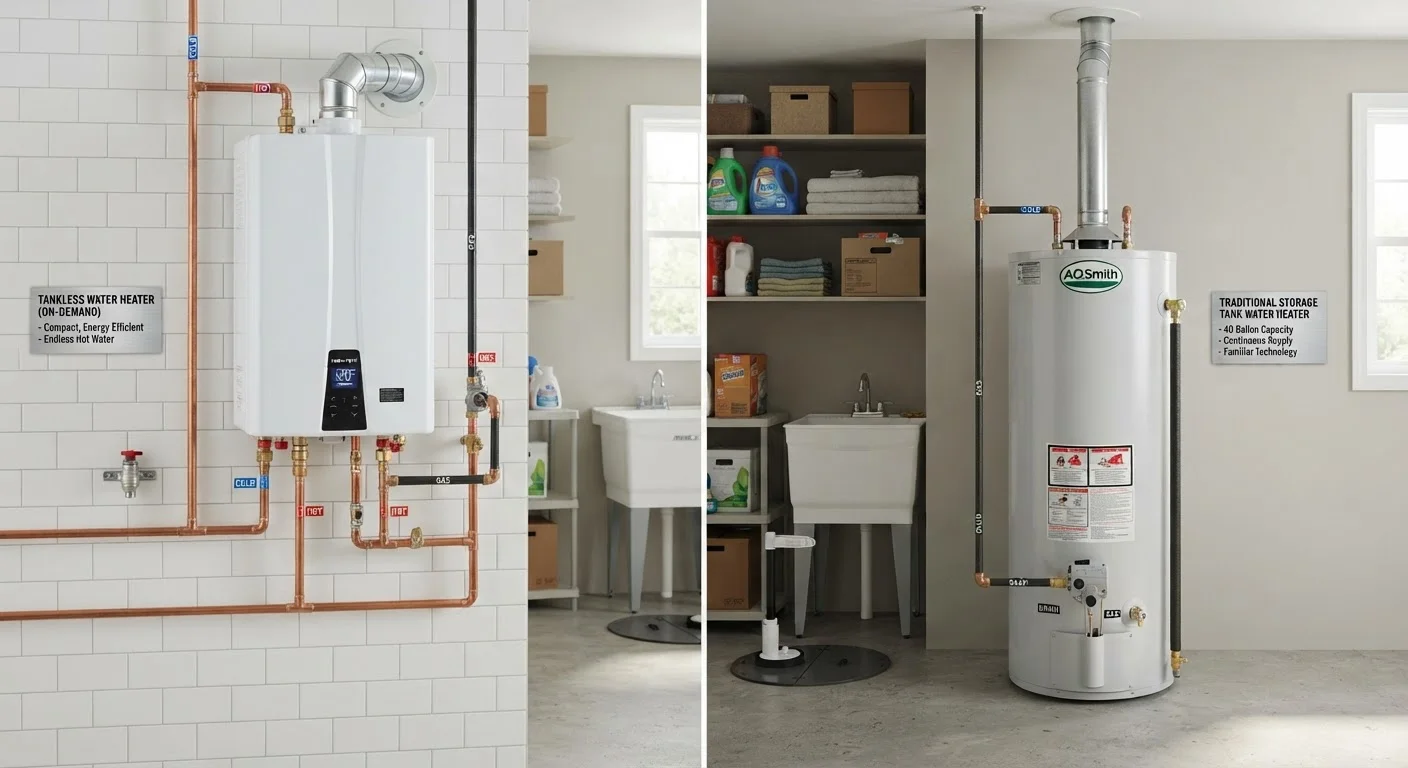
Photo credit: TurboBlogs.net | Explore Blogs At Turbo Speed
In this article
Tankless and storage water heaters have different upkeep demands. Here's a side-by-side look at what each type requires from homeowners.
Key Takeaways
- Tankless units require annual descaling of their heat exchanger, especially in hard-water areas.
- Traditional tank heaters need sediment flushing, anode rod inspection, and pressure relief valve testing each year.
- Both types benefit from inlet filter checks and periodic professional inspections.
- Neglecting maintenance on either type can cut years off the unit's expected lifespan.
- Tankless heaters generally last 20+ years; traditional tanks average 10-15 years with proper care.
- Local water hardness is the single biggest factor determining how often each type needs servicing.
How Each System Works - and Why It Matters for Maintenance
Understanding what's happening inside each unit is the foundation for knowing what to maintain. A traditional storage tank heater keeps 40-80 gallons of water continuously heated in an insulated tank. That constant heating cycle accelerates mineral buildup and corrosion, which is why tank-specific maintenance focuses on sediment, corrosion protection, and pressure management.
A tankless (on-demand) water heater has no storage reservoir. Cold water flows through a heat exchanger - a coil of tubing exposed to intense gas flame or electric elements - only when a tap is opened. Because water moves through narrow passages under high heat, scale from dissolved minerals can accumulate quickly, restricting flow and reducing efficiency.
Both designs are influenced heavily by your local water quality. Homes in hard-water regions (high calcium and magnesium content) will face faster mineral buildup in either system. Knowing your water hardness helps you set a realistic maintenance calendar for whichever unit you have. See our home maintenance schedule guide for a framework to work these tasks into your annual routine.
Side-by-Side Maintenance Requirements
The table below outlines the core maintenance tasks for each type, their typical frequency, and whether the task is generally DIY-approachable or best left to a licensed plumber or technician.
| Criterion | Tankless Water Heater | Traditional Tank Heater |
|---|---|---|
| Heat exchanger descaling | Annually (hard water); every 1-2 yrs (soft water) | Not applicable |
| Sediment flushing | Not applicable | Annually |
| Anode rod inspection | Not applicable | Every 2-3 years; replace when depleted |
| Inlet filter cleaning | Annually | Not standard |
| T&P relief valve test | Annually (where fitted) | Annually |
| Venting inspection | Annually (gas models - licensed tech) | Annually (gas models - licensed tech) |
| Typical DIY accessibility | Moderate - descaling kit required | Higher - basic tools sufficient |
| Expected lifespan with proper care | 20+ years | 10-15 years |
Note: Frequency recommendations above are general guidelines. Always consult your unit's owner's manual and a qualified plumber for guidance specific to your equipment and local water conditions.
Maintaining a Tankless Water Heater
The single most important tankless maintenance task is descaling the heat exchanger - typically done by circulating a food-grade descaling solution (such as white vinegar) through the unit using a submersible pump and hoses. In areas with hard water, this should happen annually; in softer-water regions, every 18-24 months may suffice. Skipping this step allows scale to insulate the heat exchanger, forcing the unit to work harder and potentially causing component failure.
Tankless units also have inlet filters (small mesh screens at the water and gas inlets) that trap debris before it enters the system. These should be inspected and rinsed clean at least once a year. Gas models additionally require a check of the venting system to ensure exhaust pathways are clear - a task that should be performed by a licensed technician.
20+ years
Typical tankless heater lifespan with regular maintenance
The U.S. Department of Energy notes that tankless water heaters can last more than 20 years with proper upkeep, roughly twice the lifespan of a conventional tank.
10-15 years
Average lifespan of a traditional storage tank heater
Industry guidance generally places a well-maintained conventional tank water heater's service life between 10 and 15 years, depending on water quality and maintenance frequency.
~24-34%
Potential energy savings with tankless vs. tank in typical homes
The U.S. Department of Energy estimates tankless heaters can be 24-34% more energy-efficient than storage tanks in homes that use 41 gallons or less of hot water daily.
For a broader look at plumbing upkeep tasks that complement water heater care, see our guide on plumbing maintenance tasks homeowners can safely handle.
Maintaining a Traditional Storage Tank Heater
Tank water heaters have three primary maintenance priorities. First, sediment flushing: minerals settle at the tank bottom over time, reducing heating efficiency and accelerating corrosion. Flushing the tank annually - attaching a hose to the drain valve and emptying several gallons - removes this buildup. Our article on water heater maintenance steps most homeowners skip details this process thoroughly.
Second, the anode rod - a magnesium or aluminum rod suspended inside the tank - sacrifices itself to corrosion so the tank lining doesn't. It should be inspected every 2-3 years and replaced when more than half depleted. Neglecting the anode rod is one of the most common reasons tanks fail prematurely.
Third, the temperature and pressure (T&P) relief valve should be tested annually by briefly lifting its lever. This safety device prevents dangerous pressure buildup. If the valve doesn't reset properly or drips afterward, it should be replaced by a licensed plumber - not patched. As a general principle, skipping routine maintenance always costs more in the long run.
Shared Maintenance Considerations
Regardless of type, both systems benefit from a few shared practices. Setting the thermostat to 120°F (as recommended by the U.S. Department of Energy) balances hot-water safety, energy use, and scale prevention. Both types should also have their water supply shutoff valves checked periodically to confirm they operate freely in case of emergency.
If your home has very hard water, consider installing a whole-house water softener or a dedicated scale inhibitor upstream of the heater. This is particularly impactful for tankless units, where scale in narrow heat-exchanger passages causes faster performance degradation. Consult a licensed plumber before adding treatment equipment to confirm compatibility with your existing plumbing.
Water Hardness Varies Significantly by Region
The U.S. Geological Survey reports that hard water affects a large portion of American homes, with concentrations highest in the Midwest, Southwest, and parts of the South. Your local water utility can provide a water quality report showing hardness levels, typically measured in grains per gallon (GPG) or milligrams per liter (mg/L). This figure should directly inform how frequently you schedule descaling or sediment flushing for your water heater.
This article provides general information for educational purposes only and is not a substitute for advice from a licensed plumber or qualified technician familiar with your specific equipment and local water conditions.

Author
Home & Real Estate Editorial Team
Home & Real Estate Editorial Team is the collective byline for our editorial team and contributor network. Articles published under this byline or an editorial pen name are researched, written, and reviewed according to our editorial standards for clarity, consistency, and independence before publication.
View all articles →